Sylmar Neighborhood Council

HAPPY BIRTHDAY - Sylmar High School!

Posted on 09/18/2026

Sorry that we are a bit late. I guess we will have to stay after class.

But it's worth it!

HAPPY  65th BIRTHDAY!

Sylmar Charter High School first opened its doors on September 11, 1961, in the foothills of the northeast San Fernando Valley.
 
Key Historical Milestones
  • 1961: The main high school campus officially opened.
  • 2016: Sylmar High School officially converted to become a charter high school.
Athletics and Accomplishments
  • Football Championships: The Sylmar Spartans won LA City Section football titles in 1992 and 1994.
  • Magnet Recognition: The Math-Science Magnet program has earned recognition as an "Achieving Magnet School" by the district. 


Sylmar High School is in Sylmar, a community of over 90,000 residents within the city of Los Angeles in the northeastern section of the San Fernando Valley. The community of Sylmar covers an area of 12.46 square miles. Like Los Angeles, Sylmar is a diverse community. According to the most recent census data, Latinos make up approximately 79.3% of the population, while whites account for about 11.5%. There are 5.1% Asian and 2.6% African American residents in Sylmar.  Sylmar is a bedroom community with many small family-owned businesses and a few major chain retail and fast food establishments. UCLA/Olive View Medical Center is one of the major county hospitals in Los Angeles. Pacesetters, a world-renowned manufacturer of pacemakers, and Spectrolab, a leader in the solar industry, make their home in the community of Sylmar. 
 
History of the Sylmar Community
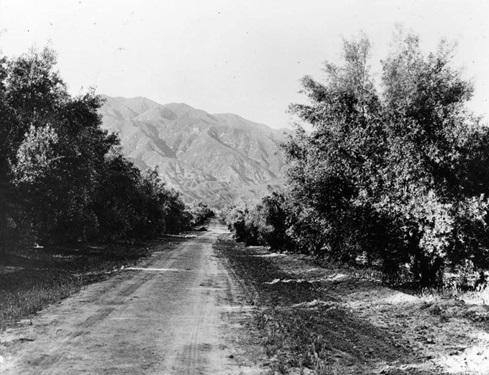
Sylmar's history begins with the Tataviam and Chumash peoples who lived here for centuries prior to the Spanish colonization. The village near the intersection of Bledsoe and Foothill in Sylmar was called Pasenga. The history of Sylmar is often intertwined with that of San Fernando. The Spanish missionaries founded Mission San Fernando Rey de España on September 8, 1797. They planted a few olive trees because the climate was much like their native land in Spain. San Fernando incorporated as its own city on September 16, 1874, leading to the naming of the unincorporated land North San Fernando as Morningside. Our community was renamed Sylmar in 1911. It is a fusion of two Latin words. Silva means forest and mare means sea. Therefore, Sylmar means Sea of Trees.

Upon learning of the new city, businessman Robert Widney published a pamphlet about the area’s perfect weather and soil for growing olives. Lured by his favorable description, a group of Decatur, Illinois businessmen bought 2,000 acres of land in 1890. In 1893, the Los Angeles Olive Growers Association was formed. The Fusano and Modougno families were among the founding growers in the area. They built a headquarters building for the olive association on Roxford and San Fernando in 1902, and the first packing plant was built in 1909. They sold olives under first the Tyler Brand and later the Sylmar Brand.  The first groves were planted with Mission, Nevadillo Blanco, and Manzanillo olives. Some Sevillano and Ascolano varieties were planted for extra-large fruit. By March 1898, about 200,000 trees had been planted, by 1906, the property had become the largest olive grove in the world
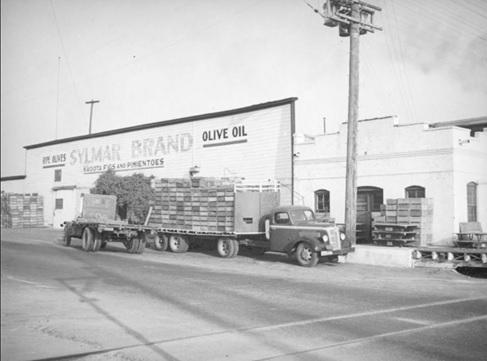
During the picking season in the early 1900s, an extra force of 300 Japanese were employed and housed in a village of tents. In 1927, the packing plant, which had been built in 1910, employed some five hundred workers during its busiest season, November through January. The oil was pressed from the fruit, allowed to separate from the fruit's water content, then drawn into 12,000-gallon concrete tanks lined with glass and set deep into the ground to avoid a change in temperature. In 1904, the Sylmar brand olive oil won first place at the Louisiana Purchase Exposition, St. Louis, Missouri; in 1906 at the Lewis and Clark Centennial Exposition, Portland, Oregon; and in 1915 at the Panama–Pacific International Exposition in San Francisco.
 
In 1913, William Mulholland and the Department of Water and Power completed the 137-mile-long aqueduct that brings water to the city of Los Angeles into the Van Norman Reservoir in Sylmar. The community of Morningside was annexed into the city and renamed Sylmar at that time. Meanwhile, the same dry air and sunshine that enabled olives to thrive drew care facilities for people with tuberculosis. Olive View Sanitarium was one of those facilities. It later became Olive View Hospital. The Veterans Administration also had a hospital for tuberculosis patients, which became Veterans Hospital. Sadly, 49 people perished when it was destroyed by the 1971 earthquake. The site is now Veteran’s Park. 
 
The olive trees would make way for tract homes, schools, and shopping centers after the Second World War. Sylmar High School was opened on a 38-acre plot of olive orchard on September 11, 1961. Sylmar retained the title of World’s Largest Olive Grove until 1966, when the town of Lindsay, in the Central Valley, was planted with a larger grove of olives. Sadly, verticillium wilt, a fungal disease, is claiming many of our older olive trees.
Roxford St. in 1937
 
 
Sylmar Brand Olive Packing Plant on Roxford St. and San Fernando Rd. 1937
 
Notable Disasters 
1966 Loop Fire
The Loop Fire started at 05:19 on November 1, 1966, from a faulty electrical line at the U.S. Army's Los Piñetos Nike Missile Site. This facility is approximately 1 mile north of Contract Point. The fire burned downhill in a southwesterly direction under the influence of 40 to 60 mile-per-hour Santa Ana winds. 
 
The El Cariso Hotshots, a U.S. Forest Service Interregional Wildland Firefighting Hotshot crew, were constructing a fire line downhill into a chimney canyon and were within 200 feet of completing their assignment when a sudden shift of winds caused a spot fire directly below where they were working. Within seconds, flames raced uphill, engulfing the firefighters in temperatures estimated to reach 2500 degrees F. The fire flashed through the 2,200-foot-long chimney canyon in less than one minute, catching the crew while they attempted to reach their safety zones.
 
Ten members of the crew died on the Loop Fire that day. Another two members died from burn injuries in the following days. Most of the 19 El Cariso crew members who survived were critically burned and remained hospitalized for some time. The Downhill Indirect Checklist, improved firefighting equipment, and better fire behavior training resulted, in part, from lives lost on this fire. El Cariso Park is named in their honor.
 
1971 earthquake
At 6:01 a.m. on February 9, a magnitude 6.5 earthquake hit the Sylmar area on a thrust fault located at the base of the mountains. Known as the San Fernando earthquake or the Sylmar earthquake, it caused 65 deaths and more than $500 million in damage. Three people died at the Olive View Medical Center, including two patients on life-support systems that failed when auxiliary generators did not start. The third was an ambulance driver who was crushed by a falling wall. One hospital building sank a foot into the ground. About 600 patients were evacuated, 200 of them into a parking lot. Veteran's Hospital suffered even greater damage. Sadly, the Veteran's Administration had opted not to reinforce one of the buildings to the standards required in California. Forty-nine people were killed when a wing of Veterans Hospital collapsed. The site of Veteran’s Hospital is now Veteran’s Park. The Sylmar juvenile hall was also severely damaged. One of its buildings sank "almost to the ceiling. See our presentation on the 1971 Sylmar Earthquake.
 
1971 explosion
Four months after the 1971 Sylmar earthquake, a methane gas explosion in a water tunnel being drilled beneath Sylmar killed 17 workers on June 24. It was the worst tunnel disaster in California history, and it resulted in the state adopting the toughest mining and tunnel regulations in the nation and the establishment of its occupational safety division, commonly known as Cal/OSHA. The incident resulted in a 54-week criminal trial against the Lockheed Shipbuilding and Construction Company — the longest municipal court trial in U.S. history at that time. The result was some of the highest municipal fines and greatest civil damage awards of that era. Nineteen Los Angeles firefighters were awarded the Medal of Valor for their work that day, a record for a single incident. A worker named Ralph Brisset, 33, was the only survivor.

 
1994 Northridge Earthquake
At 4:31 am, on January 17, 1994, a magnitude 6.7 earthquake rocked the community of Northridge, 8.5 miles southwest of Sylmar. Although the quake was not centered in Sylmar, it caused a great deal of damage to apartment buildings, commercial structures, and homes in the Sylmar community. Sylmar High School served as a Red Cross Evacuation Center after the earthquake.
 
2008 Sayre Fire
The Sayre Fire, also known as the Sylmar Fire, was first reported at 10:29 p.m. on November 14, 2008, near Veteran's Park. This was the "worst loss of homes due to fire" in Los Angeles's history. The fire burned 11,262 acres and destroyed more than 600 structures: 480 mobile homes, nine single-family homes, 104 outbuildings, and 10 commercial buildings. Most of the mobile homes lost were in the Oakridge Mobil Home Park. Five firefighters and one civilian suffered minor injuries. Sylmar High School served as a Red Cross Evacuation Center during the fire.
 
Here are the words to the Alma Mater and Fight Song.
 
Sylmar High Alma Mater
Our loyalty to thee will be
Strong throughout eternity
United in our glory now
We make this pledge to thee
Sylmar High so glorious
Will always be victorious
The blue and white of Sylmar High
Will reign forever more
 
 
Sylmar High Fight Song  Blue & White
We are for the blue and the white
Come on Spartans show them the fight
When you march that ball down the field
Hit 'em high, hit 'em low
Yeah team lets go
We're for the blue and white
 
Happy Birthday, Sylmar High School!
 

Are you sure you want to remove this?

Please enter the email address you would like to send this to