-
(818) 833-8737
13521 Hubbard St.Sylmar, CA 91342
- Login
Second Rabid Raccoon Detected in LA County
Posted on 10/23/2026

For Immediate Release:
October 23, 2026
Second Rabid Raccoon Detected in LA County
Public Health reminds everyone to never touch wild animals and ensure pets are up to date on vaccines
The Los Angeles County Department of Public Health is investigating a second rabies-positive raccoon found in the Westlake Village area of Los Angeles County. Earlier this month, Public Health reported the first rabid raccoon found in the County in more than 50 years. Public Health has confirmed that the first raccoon was positive for a variant of rabies typically found in bats. Strain testing for the second raccoon is currently pending.
“The detection of rabies in another raccoon is an important reminder to never touch, handle, or feed any wild animals, even when they appear healthy,” said Muntu Davis, MD, MPH, Los Angeles County Health Officer. “Always keep a safe distance from wildlife and contact your local animal control if you encounter an animal that appears to be sick, injured, or behaving unusually. It is also critical to ensure your pets are up to date on rabies vaccination so they are protected before any potential exposure. Keeping your pets vaccinated is one of the most important steps you can take to protect your entire family.”
The second rabid raccoon was found in a backyard in the vicinity of where the first raccoon was reported and appeared sick and aggressive. No residents or pets were exposed to the raccoon. Two people at a worksite may have been exposed to the raccoon and are receiving recommended follow-up for rabies post-exposure prophylaxis.
Rabies in Los Angeles County
Prior to these detections, the last confirmed rabid raccoon in Los Angeles County was detected in 1973, when the skunk variant (strain) of rabies was still present in the County. That strain has not been detected in Los Angeles County since 1979. In 2014, a skunk infected with the bat variant of rabies was detected in Long Beach.
Rabies remains a public health concern worldwide. Although it is preventable, it causes tens of thousands of human deaths globally each year, with most human cases linked to exposure to dogs in countries where the dog strain of rabies is still present. While the dog strain of rabies was eradicated in the United States through routine vaccination of pets, other strains of rabies continue to circulate in wildlife, including bats. All strains can infect any mammal and cause disease.
Rabies exposures in Los Angeles County are predominantly associated with contact with bats. While rabid bat detections can vary year-to-year, Los Angeles County has seen a steady upward trend for more than a decade. Peak season typically occurs in late summer, but bats with rabies can be found year-round. So far this year, there has been a record-breaking 77 rabid bats confirmed in Los Angeles County.
Public Health Reminds Everyone in Los Angeles County: Never Touch a Wild Animal & Vaccinate Your Pets
The two most important rules are simple:
- Never touch a bat or any wild animal and never allow pets to interact with them. Even small or unnoticed bites can transmit rabies.
- Vaccinate your pets: Rabies is 100% fatal in animals once symptoms begin, but completely preventable through vaccination. This includes vaccinating indoor-only cats and older pets, and ensuring your pets stay current on their rabies vaccine. Protecting your pets from rabies is one of the best ways to protect your whole family.
Other safety practices include:
- If you are bitten by a wild mammal (raccoon, skunk, opossum, coyote, etc.), seek medical advice immediately and report to Public Health: Rabies is preventable with post-exposure prophylaxis, a series of timely vaccines.
- If your pet is bitten by a wild mammal (raccoon, skunk, opossum, coyote, etc.), seek veterinary care immediately and report to your local animal control and Public Health. Your pet will need rabies vaccine and will need to temporarily quarantine at home for observation.
- Know signs of illness in bats and other wildlife: Wildlife that are ill may act more aggressive, try to interact more with humans and pets, or appear sick or uncoordinated. As bats are nocturnal, bats that are active during the day, on the ground, or unable to fly may be sick. Contact your local animal control immediately for collection and testing.
- Report bats and sick wildlife right away: If you notice sick wildlife, do not approach it, nor let your pet approach it. Call your local animal control. If you find a bat in or outside your home, especially near a sleeping person, child, or pet, carefully cover it with a box or container if it is safe to do so and call animal control immediately for collection and testing. Do not release it.
- Avoid attracting wildlife or free-roaming animals: Do not leave pet food outdoors. Do not feed or touch free-roaming animals.
- Maintain your property: Keep trash in containers with tightly fitting lids. Close off crawl spaces and seal openings where animals can enter, hide, or find food. Keep your yard free of debris and trim overgrown plants and bushes.
About Rabies
Rabies is a nearly 100% fatal viral disease in people and animals, and is caused by the rabies virus. It is most commonly transmitted through the bite or scratch of an infected animal, or when saliva from a rabid animal comes into contact with an open wound or mucous membranes (such as the eyes, nose, or mouth). The virus affects the central nervous system. Once symptoms appear, rabies is almost always fatal. However, timely administration of rabies post-exposure prophylaxis after a potential exposure is highly effective at preventing disease.
Symptoms include:
- In people: initially vague symptoms including fever, weakness, headache; progressing to tingling sensation, anxiety, agitation, abnormal behavior, hallucinations, difficulty swallowing, coma, death.
- In animals: initially non-specific signs (vomiting, respiratory distress) progressing into neurologic signs – circling, difficulties walking, behavior change, aggression, paralysis, hydrophobia (fear of water), death.
Rabies can affect both wild and domestic animals. In the United States, most reported animal rabies cases occur among wildlife, particularly bats, skunks, raccoons, and foxes. People become infected through contact with infected animals, including pets or wildlife. The virus is not spread through casual contact, touching an animal, or through blood, urine, or feces.
For more information about rabies, visit: http://publichealth.lacounty.

Represent Your Community
FIRE! Be Ready! Tree Dangers

Sign-Up to Receive Agendas

Sylmar Community Calendar

MyLA311



My LA 311
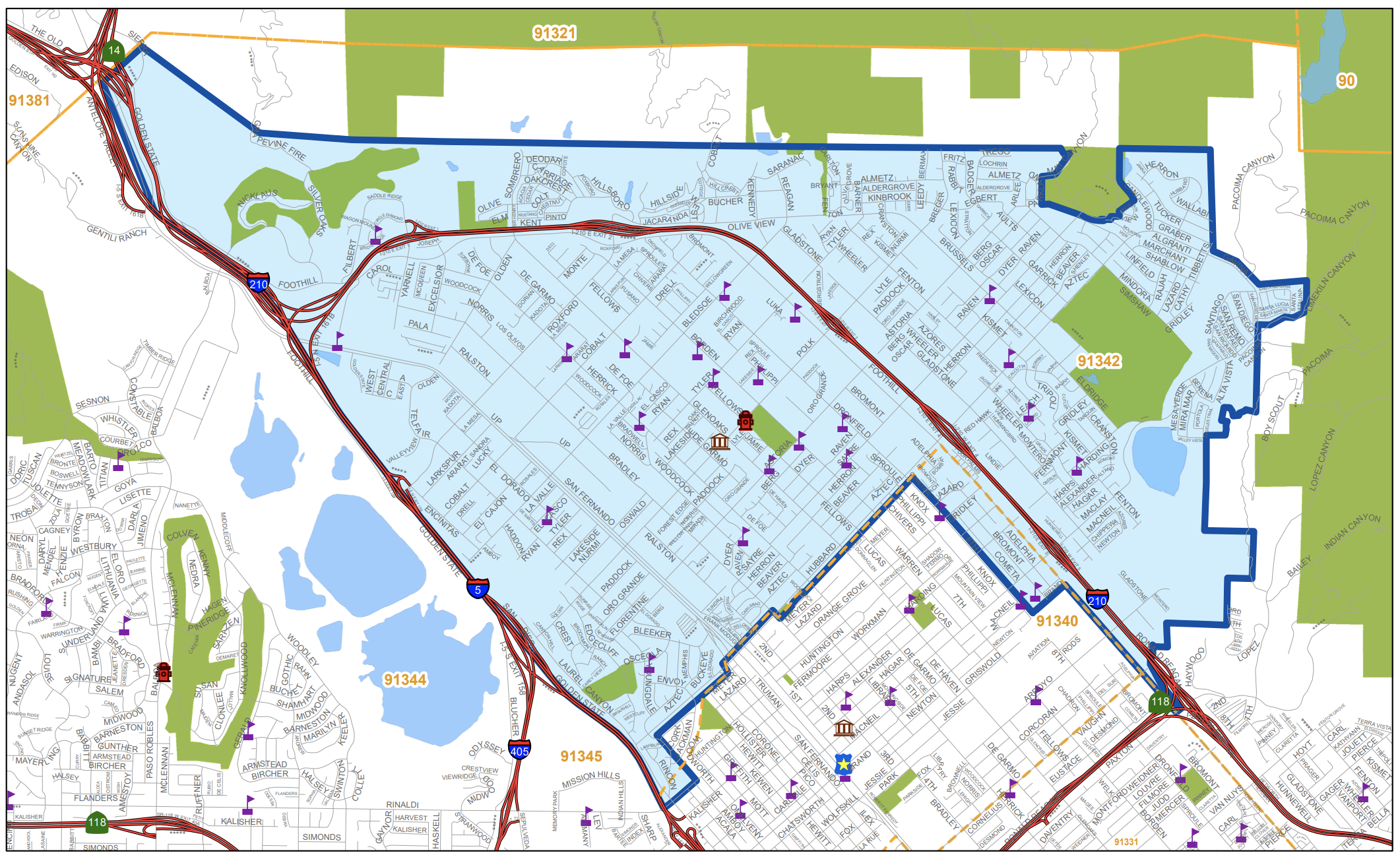
Area Boundaries and Map
View our neighborhood council boundaries for which we deal with.

EMPOWER LA

NEIGHBORHOOD COUNCIL CALENDAR & EVENTS
The public is invited to attend all meetings.

NEIGHBORHOOD COUNCIL FUNDING SYSTEM DASHBOARD

SUBSCRIBE TO NC MEETING NOTIFICATION