
-
(818) 833-8737
13521 Hubbard St.Sylmar, CA 91342
- Login
New California Laws take effect on January 1st, 2026
Posted on 12/26/2025
In 2026, California will implement over 900 new laws covering consumer rights, workplace standards, public safety, and education. Most of these laws take effect on January 1, 2026, unless otherwise noted.
Consumer Protections & Daily Life
- Plastic Bag Ban (SB 1053): All plastic shopping bags are banned at grocery stores, pharmacies, and convenience stores. Retailers may only provide recycled paper bags for a minimum fee of 10 cents.
- Used Car Return Rights (SB 766): Starting October 1, buyers have a 3-day window to return a used vehicle for a full refund. Dealers must also disclose full costs upfront and are barred from charging for non-beneficial add-ons.
- Food Delivery Refunds (AB 578): Apps like Uber Eats and DoorDash must provide full refunds if an order is not delivered or is incorrect. They must also offer human customer service if automated systems fail.
- Renters' Rights (AB 628): Landlords must provide and maintain a working stove and refrigerator in all new rental units.
- Overdraft Fee Cap (SB 1075): Credit unions are prohibited from charging more than $14 for an overdraft or non-sufficient funds fee.
- Streaming Ad Volume (SB 576): Starting in July, streaming services cannot play advertisements at a higher volume than the content being watched.
Workplace & Employment
- Minimum Wage Increase: The statewide minimum wage rises to $16.90 per hour for all employees. The exempt salary threshold increases to $70,304 annually.
- "Stay or Pay" Ban (AB 692): Employers are generally prohibited from requiring workers to repay training or relocation costs if they leave their jobs.
- "Workplace Know Your Rights" Act (SB 294): Employers must provide an annual written notice explaining rights such as workers' compensation, immigration protections, and union organizing.
- Equal Pay Expansion (SB 642): Protections against pay disparities are expanded to include non-binary employees, and the definition of "wages" now includes bonuses and benefits.
- Tip Theft Enforcement (SB 648): The Labor Commissioner gains express authority to investigate and issue citations for withheld tips.
Public Safety & Law Enforcement
- Mask Ban for Officers (SB 627): Most law enforcement officers are prohibited from wearing face masks while on duty. This law is currently facing federal court challenges.
- Sexual Assault Litigation (AB 250): Survivors can revive civil claims for sexual assault through December 31, 2027, even if the statute of limitations has passed.
- Cat Declawing Ban (AB 867): Declawing cats is prohibited unless medically necessary.
- E-Bike Safety (SB 1271): New standards require e-bike batteries and charging systems to be tested and labeled to reduce fire hazards.
Education & Health
- Phone-Free Schools (AB 3216): Public K-12 schools must limit/prohibit student smartphone use by July 1.
- Low-Cost Insulin (SB 40): Co-pays for a 30-day supply of insulin are capped at $35 for state-regulated plans. California will also sell its own branded insulin (CalRx) for about $11 per pen.
- Automatic CSU Admission (SB 640): Qualified high school graduates will be automatically admitted to a CSU campus for the 2026-2027 school year.
- New State Holiday (AB 268): Diwali is recognized as an official state holiday.
Californians who order food through apps such as DoorDash, Uber Eats and Grubhub will see changes in how delivery platforms handle refunds, tips and customer service under Assembly Bill 578, a consumer protection bill signed this fall by Newsom.
Under the new law, food delivery companies must give customers full refunds to their original payment methods when orders are late, wrong or never completed, instead of just offering credit toward future purchases. Platforms also have to offer a real person for customer support, not just chatbots or automated menus. Under the law, delivery apps must show an itemized breakdown of pay and fees and may no longer use tips or gratuities to offset a driver’s base pay.
The bill was inspired by its author Assemblymember Rebecca Bauer-Kahan’s own experience ordering pizzas for her daughter’s bat mitzvah; she had paid for 12 pizzas, but only one showed up, as she shared in a Senate committee hearing earlier this year.
TRAFFIC / CA Drivers
The California DMV is reminding drivers about new laws set to take effect in 2026 that aim to make roads safer.
Here’s a breakdown of what motorists need to know.
Ignition Interlock Devices
Assembly Bill 366 extends California’s statewide Ignition Interlock Device program for certain DUI offenders through Jan. 1, 2033. Drivers required to participate must use a breath-activated device that prevents a vehicle from starting if alcohol is detected.
The pilot program applies to DUI offenders convicted of a DUI involving alcohol or a combination of alcohol and drugs.
Vehicular Manslaughter While Intoxicated
Assembly Bill 1087 increases probation terms for those convicted of vehicular manslaughter or gross vehicular manslaughter while intoxicated from two years to between three and five years.
School Zone Speed Limits
Beginning Jan. 1, 2031, the default speed limit in school zones will be lowered from 25 mph to 20 mph, under AB 382.
“Slow Down, Move Over”
Assembly Bill 390 expands California’s “slow down, move over” law to require drivers to change lanes or slow down when approaching any stationary vehicle displaying hazard lights or warning devices.
Automated Red-Light Enforcement
SB 720 allows cities and counties to operate alternative automated camera programs to enforce red-light violations. Violations remain civil infractions rather than criminal offenses.
License Plate Obstruction
The new law makes it an infraction, punishable by fines of up to $1,000, to manufacture in California products designed to obscure or interfere with the visual or electronic reading of license plates.
Abandoned Recreational Vehicles
AB 630 authorizes Los Angeles and Alameda counties, through Jan. 1, 2030, to remove and dispose of abandoned recreational vehicles valued at $4,000 or less if a public agency verifies the RV is inoperable.
Autonomous Vehicle Marker Lamps
SB 480 permits autonomous vehicles to be equipped with an automated driving system or ADS marker lamps. The lamps notify other drivers, pedestrians and law enforcement when an autonomous vehicle’s ADS is activated.
Off-Highway Electric Motorcycles
SB 586 classifies off-highway electric motorcycles, commonly called eMotos, as off-highway motor vehicles.
California Combating Auto Retail Scams (CARS) Act
The CARS Act prohibits auto dealers from misrepresenting vehicle prices, financing terms, and optional add-ons. It also provides buyers or lessees of vehicles priced under $50,000 a three-day right to cancel the transaction.
“DMV” in Website Addresses
AB 1272 prohibits businesses holding DMV-issued occupational licenses from using “Department of Motor Vehicles” or “DMV” in their internet domain names.
Duplicate Driver’s License After Address Change
Under SB 506, drivers who update their address with the DMV are allowed to request a duplicate driver’s license showing the new address.
Parking Tickets
AB 1299 authorizes local governments to waive or reduce parking fines when a person demonstrates an inability to pay and requires agencies to offer payment plans upon request.
Parking ticket waivers
Local California governments can now ease the burden of parking fines by reducing, suspending or waiving penalties for people who show financial hardship, including homelessness or inability to pay. The law also lets individuals apply for a parking citation payment plan. Assembly Bill 1299 takes effect on Jan. 1 and applies statewide to local parking enforcement practices.
Tortillas require a new ingredient
A new law will require most commercially sold corn masa flour and corn tortillas to be fortified with folic acid. The B vitamin reduces the risk of birth defects during pregnancy. Corn masa products, common in many Latino households, were historically exempt from federal folic acid fortification rules that apply to wheat flour. State health officials estimate the change could help prevent dozens of severe birth defects each year. The law includes exemptions for certain small producers and fresh masa made on-site.
Ban on cat declawing
Veterinarians in California will be banned from declawing cats, except when the procedure is medically necessary to treat illness or injury. Declawing to prevent furniture scratching will no longer be allowed. Supporters say the surgery, which involves amputating the last bone of each toe, causes chronic pain. The practice is already banned across most of Europe and other countries.
A California crackdown on AI chatbots
AI chatbots designed to simulate emotional or personal relationships with users are the target of Senate Bill 243. Companies operating chatbots in California must clearly disclose that users are interacting with artificial intelligence, not a human. The law also requires platforms to implement safeguards to reduce the risk of self-harm, including protocols for responding to suicidal ideation and providing crisis resources. Lawmakers describe the bill as a first-in-the-nation attempt to put guardrails around a rapidly expanding corner of consumer AI.
Law enforcement must disclose AI use
As the use of artificial intelligence becomes more and more common in workplaces, Senate Bill 524, signed into law in October, requires law enforcement agencies to disclose if they used AI to write official reports. Law enforcement agencies are now required to have an AI disclosure policy where they clearly mark that “this report was written either fully or in part using artificial intelligence.” In addition, the officer who made the report must sign their name to the document and confirm they verified the information in it.
California law limits immigration enforcement at schools
California’s Assembly Bill 49, also known as the Safe Haven Schools Act, strengthens protections for students and families by restricting immigration enforcement on K-12 campuses. The law bars school officials from allowing immigration agents into nonpublic areas of schools unless they present a judicial warrant or court order, and it limits the sharing of student or family records with immigration authorities without proper legal authorization. “California is home to over 750,000 K-12 students with undocumented parents and fear of immigration enforcement disrupts their ability to learn and thrive,” Assemblymember Al Muratsuchi, author of the bill, said in a statement. “AB49 ensures that schools continue to be safe havens where all students, regardless of their family’s immigration status, can pursue their education without the looming threat of deportation.”
California gets a new state holiday
Mark your calendars: In 2026, Californians will get the day off to celebrate Diwali, one of the most important holidays of the year for Indian Americans and South Asian Americans. The festival of lights is set by the lunar calendar, which means its date changes from year to year. Diwali always takes place in the fall, and the Bay Area is home to the largest Diwali celebration in North America. In 2026, it falls on Nov. 8, which means the holiday will be observed on Monday, Nov. 9.
More protections for employees who get tips
Employees who receive tips from patrons already have a number of protections in California, but Senate Bill 648 adds a few more. Employers cannot deduct a credit card fee from tips, and employees are owed their tips left by credit card no later than “next regular payday following the date the patron authorized the credit card payment.” Employers who violate these rules can be investigated by the state Labor Commissioner’s Office, which can cite them or file a lawsuit in civil court against them.
Single-use plastic bag ban — but for real this time
Single-use plastic bags have already been banned in much of California for years. But according to legislators, a loophole in the law was allowing manufacturers to still supply plastic bags to grocery stores. Thicker plastic bags, like the kind at Safeway checkout counters, were considered reusable, thus allowing for their sale to customers who didn’t bring their own bags. Those will no longer be allowed under the new law, which means plastic bags will now disappear entirely from supermarkets. So be sure to bring your totes on your next shopping trip.
Insulin price cap
Starting Jan. 1, large health insurers in California will be required to cap the insulin copay at $35 for a 30-day supply. Individual and small-group plans will face the same price cap in 2027. Around 2 million Americans have insulin-dependent diabetes and require insulin to live. The move has been applauded by the American Diabetes Association.
“For far too long, many Americans with diabetes have made the difficult decision to ration this lifesaving medication to pay for other necessities, such as groceries or rent,” the organization said in a statement. “This legislation will provide much-needed financial relief for people living with insulin-dependent diabetes.”
Landlords must provide a stove and fridge
Tenants who sign, amend or extend leases after Jan. 1 have the right to a stove and a refrigerator, thanks to Assembly Bill 628. The law stipulates landlords must provide tenants with these appliances, in good working order, unless a tenant agrees when signing the lease to provide their own. Landlords must also make sure stoves and fridges are repaired or replaced within 30 days if the appliances are subject to a recall.
This is only a short example of some of the new laws that will take effect in 2026.
Represent Your Community

FIRE! Be Ready! Tree Dangers

Sign-Up to Receive Agendas

Sylmar Community Calendar
MyLA311


My LA 311
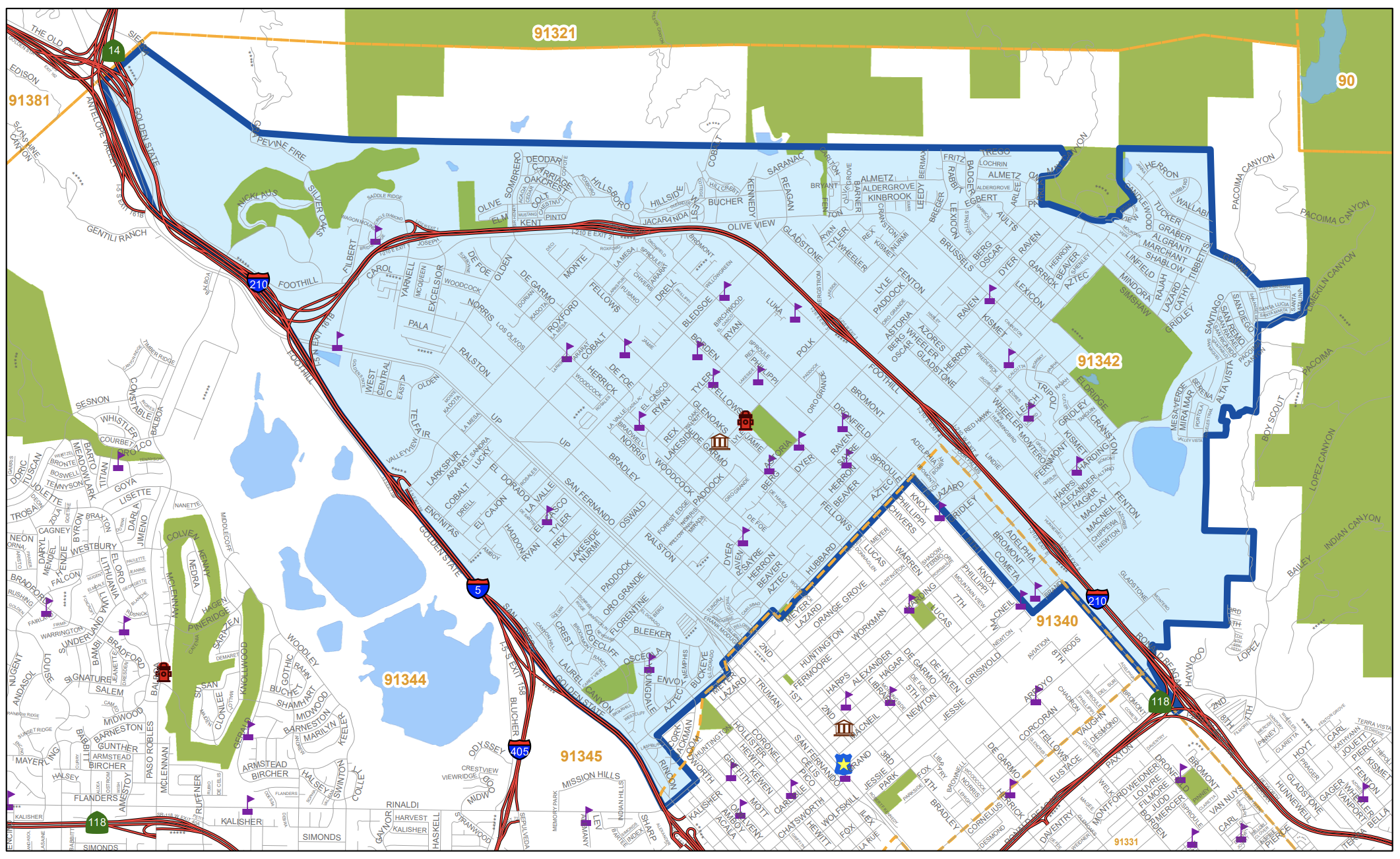
Area Boundaries and Map
View our neighborhood council boundaries for which we deal with.
EMPOWER LA

NEIGHBORHOOD COUNCIL CALENDAR & EVENTS
The public is invited to attend all meetings.
NEIGHBORHOOD COUNCIL FUNDING SYSTEM DASHBOARD
SUBSCRIBE TO NC MEETING NOTIFICATION